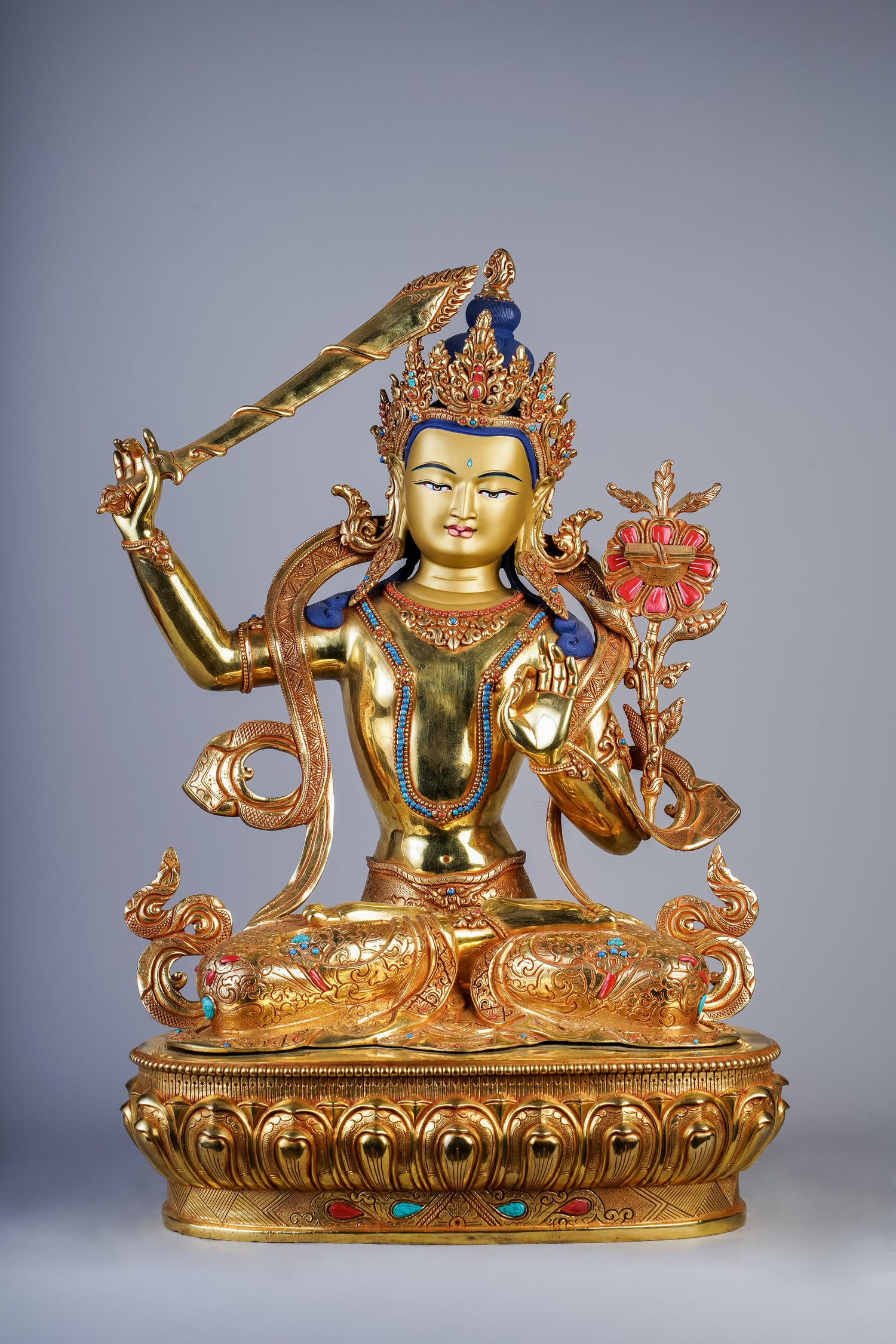
Manjushree: The Bodhisattva Who Wields the Sword of Wisdom
From Lake to Valley: The Legend of Mañjuśrī in ...
The Swayambhu Purana narrates the mythical transformation of Kathmandu Valley from a vast lake into a thriving settlement, guided by the wisdom of Mañjuśrī. This ancient Buddhist text recounts the...
From Lake to Valley: The Legend of Mañjuśrī in ...
The Swayambhu Purana narrates the mythical transformation of Kathmandu Valley from a vast lake into a thriving settlement, guided by the wisdom of Mañjuśrī. This ancient Buddhist text recounts the...
SKT. Mañjuśrī(मञ्जुश्री) | TIB. ’jam dpal dbyangs(འཇམ་དཔལ་དབྱངས) | CH. 文殊菩薩 | VIET. Văn Thù Bồ Tát
Manjushri, the Bodhisattva of Transcendent Wisdom, holds a revered place in Buddhist traditions, particularly in Vajrayana Buddhism. In Vajrayana, wisdom (prajñā) is seen as the ultimate path to enlightenment, making Manjushri an essential figure in its practices. His invocation is believed to grant insight, clarity, and an understanding of the true nature of reality, which are fundamental aspects of Vajrayana enlightenment practices.
-
The Vajraparyanka Posture
The vajraparyanka posture (also called padmasana or lotus position) represents the stability and firmness of wisdom. Just as wisdom remains unshaken, the vajraparyanka posture is firm, grounded, and symmetrical. This posture is common in depictions of bodhisattvas and meditating Buddhas.
-
The Ornaments and Jewels
The ornaments and jewels worn by Manjushri signify his status as a bodhisattva and his embodiment of the “royalty” of wisdom. Bodhisattvas are depicted like celestial princes, adorned with golden crowns, earrings, armlets, and anklets. These ornaments symbolize the perfection of wisdom, compassion, and spiritual wealth.
-
Appearance
Manjushri is often depicted with a youthful countenance, signifying that wisdom transcends age and remains eternally fresh and relevant.
Wisdom, unlike age, is not bound by time. Youthfulness represents the dynamic and ever-renewing nature of enlightened insight. He sometimes appears slightly fiercer, emphasizing his power to destroy ignorance.
-
Nilotpala with Prajnaparamita Sutra
The Prajnaparamita Sutra represents transcendent wisdom, the ultimate understanding of reality beyond conceptual thought. These texts form the philosophical foundation of Mahayana Buddhism. Manjushri holds a nilotpala with the Prajnaparamita Sutra resting upon it, while another nilotpala may support his flaming sword. It represents the perfection of wisdom (prajñā-pāramitā), which remains untouched by the defilements of the world, just as the water lily floats above murky waters.
-
Chandrahasa
In his right hand, Manjushri wields a flaming sword, symbolizing the realization of transcendent wisdom that cuts through ignorance and duality. This sword represents the sharpness of wisdom that slices through illusion, leading to clarity and enlightenment. The flames symbolize enlightenment burning away delusion and dualistic thinking.
-
Vitarka Mudra: The Gesture of Teaching and Discussion
The Vitarka Mudra signifies intellectual debate, teaching, and the transmission of wisdom. The Vitarka Mudra represents the continuous flow of wisdom and knowledge and the unbroken cycle of teaching and learning. In representations of Mañjuśrī, the Vitarka Mudra is commonly associated with his left hand holding the Nilotpala.
History and Legends - The Draining of the Kathmandu Valley
The Kathmandu Valley has long been the subject of both religious legend and scientific inquiry. According to Buddhist tradition, Bodhisattva Manjushri played a crucial role in transforming the valley into habitable land. The Svayambhu-Purana recounts how Manjushri used his flaming sword, Chandrahasa, to cut a cleft into the surrounding mountains, allowing the water to drain. This act revealed the sacred hill of Swayambhu, making the land suitable for human settlement.
Similarly, Hindu tradition offers an alternative explanation, attributing the draining of the lake to Pradyumna, the son of Krishna. In this version, Pradyumna released the river goddess Bagvati (the Bagmati River) from a demon’s grasp, allowing the valley to be formed. Another variation credits Krishna himself with using a divine thunderbolt to break open the gorge, enabling the waters to flow out and rendering the valley habitable. These legends have been passed down for generations, shaping the cultural and religious landscape of Nepal (Hutt, 2011).
While these legends have been passed down for generations, modern research suggests a compelling correlation between these myths and geological changes in the region. Scientific studies confirm that the Kathmandu Valley was once submerged under a vast lake, known as Paleo-Kathmandu Lake. Sedimentological and palynological analyses reveal lacustrine deposits,confirming the presence of an ancient lake. Research suggests that the lake formed approximately 1 million years ago due to the damming of the Bagmati River and persisted until about 12,000 years ago. The drainage of the lake likely occurred in phases due to tectonic uplift, faulting, and the natural erosion of river channels. Soft-sediment deformation structures within the basin's deposits further indicate seismic activity played a role in the lake’s drainage process. This scientific understanding not only supports but also enriches the traditional Buddhist and Hindu narratives, demonstrating how ancient myths and modern science converge to explain the transformation of the Kathmandu Valley (Sakai, 2001).
Manjushri’s Role in Buddhism
Manjushri is regarded as the Bodhisattva of Transcendent Wisdom due to his association with the Prajnaparamita Sutras, which focus on the "Perfection of Wisdom." These texts emphasize emptiness (śūnyatā) and the realization of ultimate truth beyond conventional understanding(Padmasambhava, 2016). Manjushri is often depicted holding a flaming sword, symbolizing the sharpness of wisdom that cuts through ignorance and dualistic thinking.
Manjushri is also referred to as the "Mother of All Buddhas" because wisdom is the essential foundation for attaining Buddhahood. Traditionally, Prajnaparamita—the perfection of wisdom—is called the "Mother of All Buddhas" because it is through wisdom that enlightenment is realized(The Five Houses of Zen, 1997).
Manjushri’s practices often include the recitation of specific mantras and the performance of sadhanas (ritual meditations). The Arapacana mantra is associated with enhancing wisdom and improving memory, debate skills, and literary abilities. The syllables of this mantra are believed to represent various aspects of wisdom and are used as a focus for meditation (Meshram, 2017). These practices are not limited to esoteric traditions but are widely adopted across various Mahayana Buddhist schools, emphasizing wisdom cultivation in both monastic and lay settings.
Wrathful Manifestations
Another significant tantric form of Manjushri is Vajrabhairava, a fierce deity represented with a buffalo head, exhibiting a wrathful expression and teeth resembling swords. Vajrabhairava, also known as Yamantaka, is both the "destroyer of the lord of death" and as an emanation of Manjushri, functions to increase wisdom in his practitioners that destroys the ego and conquers death, symbolizing the ultimate overcoming of ignorance and the cycle of rebirth (The Roar of Thunder,2021).
These esoteric and tantric practices centered around Manjushri are integral to Vajrayana Buddhism, offering practitioners methods to develop deep wisdom and achieve enlightenment. Practitioners visualize themselves as Manjushri to merge their consciousness with his enlightened qualities.
References
Hutt, Michael. (2011). The Pradyumna-Prabhāvati legend in Nepal: a study of the Hindu myth of the draining of the Nepal valley. By Horst Brinkhaus. (Alt- und Neu-Indische Studien, hrsg. vom Seminar für Kultur and Geschichte Indiens an der Universität Hamburg, 32.)pp. viii, 398. Stuttgart, Franz Steiner Verlag Wiesbaden GmbH, 1987. DM 56.. Journal of the Royal Asiatic Society of Great Britain & Ireland. 120. 445-446.10.1017/S0035869X00142091.
Meshram, M. T. (2017). The Signification of Bodhisattva Manjushri in Mahayana Buddhism.Shabd Brahma: International Research Journal of Indian Languages, Indore, M.P. India.
Padmasambhava. (2016). Dzogchen Deity practice: Meeting Your True Nature. Rangjung Yeshe Publications.
Sakai, H. (2001). Stratigraphic division and sedimentary facies of the Kathmandu Basin Group, central Nepal. Journal of Nepal Geological Society, 25, 19–32.https://doi.org/10.3126/jngs.v25i0.32043
The Five Houses of Zen. (1997). Shambhala Publications.
The roar of Thunder: Yamantaka Practice and Commentary. (2021). Wisdom Publications.
-
Vajrapani
Vajrapāņi, the Bodhisattva of Power or Energy, is intimately connected with the Vajrayāna because the Vajrayāna sees everything in terms of energy. He takes the initiative in ceaselessly working for the good of all sentient beings. He embodies spiritual heroism, daring to face our own projected power, re-own it, and place it at the service of the Dharma.
The path of Vajrapāņi is one of overcoming fear. It is very much concerned with seeing the entire universe as consisting of energy and harnessing that energy for spiritual development. Vajrapāņi's path is one of activity, of taking the risk of trying to change, not of sitting back and grumbling about how things are. Vajrapāņi offers the prospect of seizing the vajra, of entering the spiritual battleground as a warrior, like a great warrior or a champion of Dharma.
In his peaceful form, he sits radiant, young, smiling, a vajra resting in his palm like a gift of clarity. In his wrathful form, he blazes like a wrathful tempest, crowned in skulls, garlanded in flames, his roar tearing through spiritual stagnation. Both aspects arise not in opposition but in unity, the stillness of absolute power and the fierce dance of compassionate protection.
-
Avalokitesvara
Mantra: Om Mani Padme Hum
Aavalokiteshvara is a Bodhisattva deity symbolizing wisdom and compassion. The name Avalokiteshvara means ‘the Lord who looks upon the world with compassion’ in Sanskrit. In Tibetan Buddhist traditions, this deity is regarded as the sovereign protector of Tibet, often referred to as 'The Protector of the Land of Snows.' In Mahayana traditions, Avalokiteshvara is viewed as a meditational wisdom deity, or yidam, associated particularly with the qualities of Metta, loving-kindness and Karuna, compassion. Avalokiteshvara is also referred as Karunamaya, The Compassionate One and Lokeshvara, The Lord of the whole world, in Kathmandu Valley, Nepal.
-
Yamantaka
Yamāntaka (Tibetan: Shinje She, Sanskrit: Yama-antaka, “Destroyer of Yama”) is one of the most terrifying yet liberating deities in Vajrayāna Buddhism. He appears in a wrathful form, not out of anger but as a fierce expression of wisdom — the embodiment of Mañjuśrī’s ultimate compassion in action. His primary role is to conquer death, subdue inner and outer obstacles, and annihilate ignorance at its roots.
The practice of Yamāntaka belongs to the Highest Yoga Tantra (mahā-anuttarayoga tantra), which emphasizes that intense emotions like anger are not rejected but transformed into wisdom on the path to enlightenment. Across the Tibetan tantric traditions, particularly within the Gelug school, Yamāntaka is known as Vajrabhairava and most commonly visualized in his Solitary Hero (Ekavīra) form. This configuration — with nine faces, thirty-four arms, and sixteen legs — symbolizes the comprehensive and unstoppable power of enlightened wisdom. Yamāntaka is the most powerful method for overcoming spiritual obstacles in the degenerate age, and without relying on a deity such as Yamantaka, practicing Dharma and actualizing the entire path to enlightenment is very, very difficult, particularly when karmic obscurations and inner defilements dominate the mind.
To engage in Yamāntaka practice is to step into a fire. But it is not a fire that consumes; it is a fire that purifies. Through wrath, one finds peace. Through terrifying form, one finds radiant wisdom. Through death’s destruction, one finds life unfettered by illusion. In every shout, every weapon, every glance of this fearsome deity is the silent teaching of emptiness. Yamāntaka is not just the end of death—he is the beginning of unshakable freedom.
Handmade statues of Manjushree
-
14 inch/ 35 cm Manjushree
Regular price $630.00Regular priceSale price $630.00 -
14 inch/ 38 cm Manjushree
Regular price $1,000.00Regular priceSale price $1,000.00 -
14 inch/ 38 cm Manjushree
Regular price $1,000.00Regular priceSale price $1,000.00 -
14.5 inch/ 37 cm Manjushree
Regular price $1,105.00Regular priceSale price $1,105.00